dreamstate 💭
Reem Najjar
Intelligence already existed
Biology is the most advanced technology we have ever seen.
- Neri Oxman

Before we designed intelligence, it was already alive. We talk about Artificial Intelligence as if it is something new that we are finally learning to create. But intelligence, un-artificially, was never something we had to invent. It has always been present, embedded within nature, our cities, our bodies, cultures, and systems, waiting to be recognized. Dreamstate is the moment before creation, the field before form. It is the vibration before something becomes visible, where intelligence feels less artificial and more ancient.
Slime mold, ant colonies, bird flocks, forests, human organisms, and now artificial systems are all part of the same larger question: how do systems organize, adapt, and become aware of themselves? Intelligence is not always centralized, nor does it require a brain, a command center, or a visible point of control. It emerges through relationships, feedback loops, and repeated actions across a system. In the Tokyo subway experiment, Japanese researchers placed oat flakes on a map of the Tokyo region to represent major urban centers. Slime mold, an organism with no brain or nervous system, expanded outward from the oats, then reorganized itself into the most efficient pathways between them.
The resulting network closely resembled Tokyo’s rail system, which took engineers decades to design, while the mold formed its network in under two days. Nature already holds our most efficient, resilient, and adaptive systems. The point is not that mold is smarter than human engineers. It is that intelligence can emerge without being centrally designed or defined by the model of a human brain. What we call AI is not the creation of intelligence, but a mirror that helps us recognize the intelligence that has always existed.
Presence and intuition
We cannot live only for ourselves. A thousand fibers connect us with our fellow men.
- Herman Melville
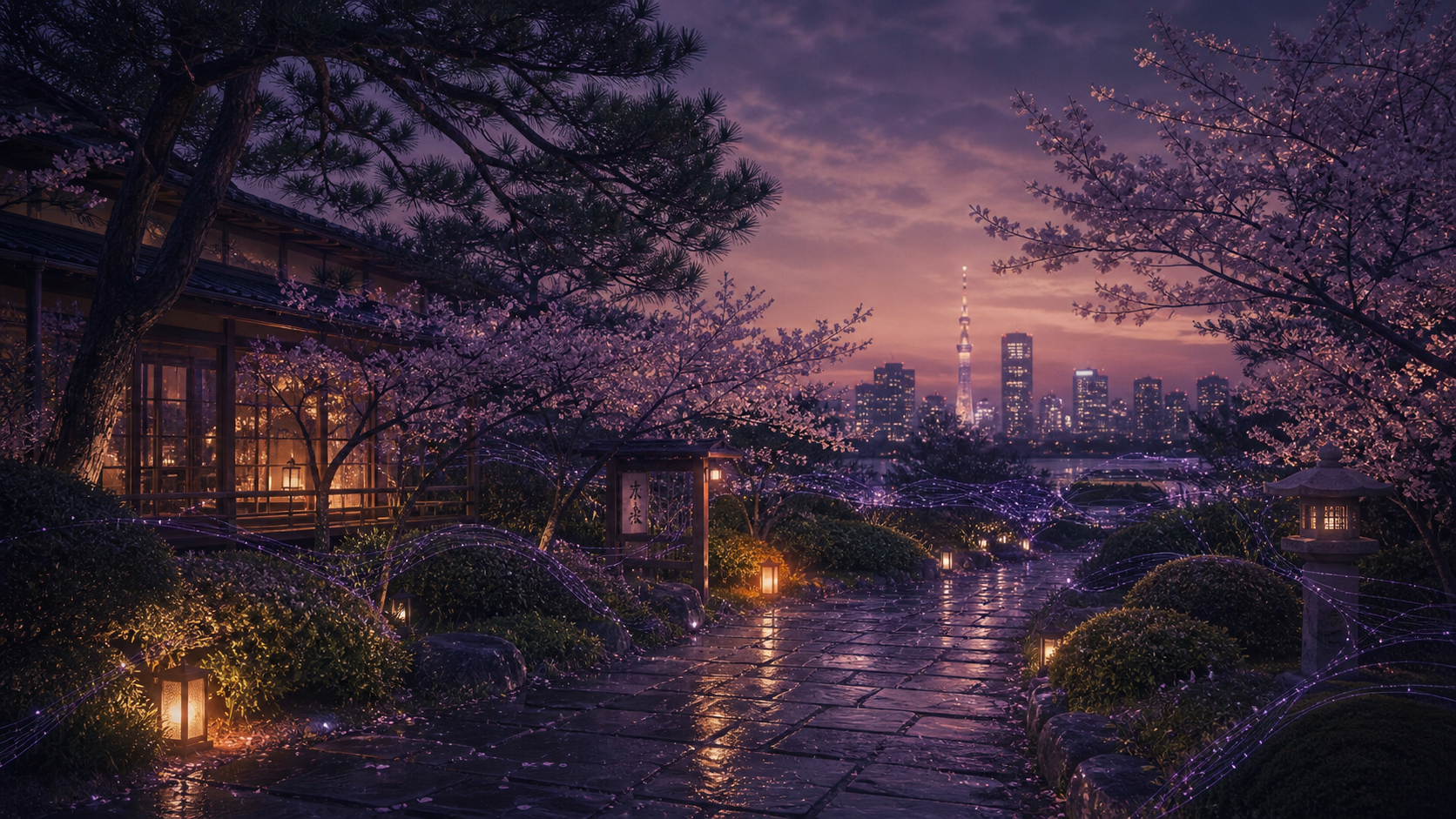
The most intelligent systems don’t feel like technology. Smart cities should feel like intuition, naturally integrated within the environment. Systems should dissolve into the background until the experience feels effortless and invisible, like the hidden forces that shape spatial harmony and mold social rhythm. If intelligence emerges through networks, then our environments are not passive containers. They hold the power and responsibility to shape how we think, move, and behave. One street can slow you down, a plaza can invite gathering, and a room can hold conversation.
One digital interface can quiet your mind, a smartwatch can heighten awareness, and a wearable ring can offer a subtle sense of reassurance. Over time, designed environments become absorbed into daily life. They influence repeated behaviors, which become habits that begin to shape identity. This is where design moves beyond function and into quiet influence. Dreamstate begins before something is built. It exists as a state, an atmosphere of thought, a vibration before form. Design is not only the creation of objects or systems, it is the shaping of conditions.
We see this in nature. Ant colonies coordinate through simple signals. Bird flocks move as one without a leader. Forests communicate through underground fungal networks, sharing nutrients and information across entire ecosystems. These are not controlled systems, they are attuned ones. Data now moves in a similar way, looping signals back into the system, allowing it to sense, adjust, and evolve without announcing itself. Intelligence is not something we use or create, it is something we live inside, and something that lives back through us.
Expression of density and intensity
As above, so below.
- Hermitic Principle

Intelligence is a direct adaptation of its environment. Depending on pace, density, culture, and scale, cities and even the neighborhoods within them express themselves differently. In Austin, downtown moves fast, dense, and transactional, while in Zilker everything slows, opens, and breathes. Green space expands, people linger, movement softens. Residents of the same city begin to behave differently, shifting value systems with context. We see this at a larger scale in the contrast between the U.S. and Japan, where cultural norms such as public space noise control, social rhythms such as walking behavior, and collective awareness such as attitudes toward trash, cleanliness, and eating in public are shaped by their environments.
In Tokyo, intelligence appears as precision and intensity. Trains arrive within seconds. Crowds move in quiet coordination. Large intersections clear without chaos, even when thousands cross at once. There is no visible orchestrator, yet the city moves as if it shares a nervous system. Intelligence is embedded in timing, etiquette, infrastructure, and collective awareness. That same intelligence becomes slower and more spatial in places like Kyoto. Concepts like Ma, the intentional use of pause and negative space, and Shakkei, borrowed scenery that integrates surrounding nature, guide experience without force.
Paths, windows, gardens, rivers, and mountains subtly shape movement and attention. Visiting these cities, I saw that intelligence does not have a fixed aesthetic. Intelligence adapts across scales, from room to home, neighborhood to city, and county to country. It can be dense and fast for those seeking energy, or quiet and intuitive for those seeking presence. The measure of an intelligent city is not defined by what is built, but by how what is created responds to the context in which it exists.
Realignment of placemaking
We shape our buildings; thereafter they shape us.
- Winston Churchill
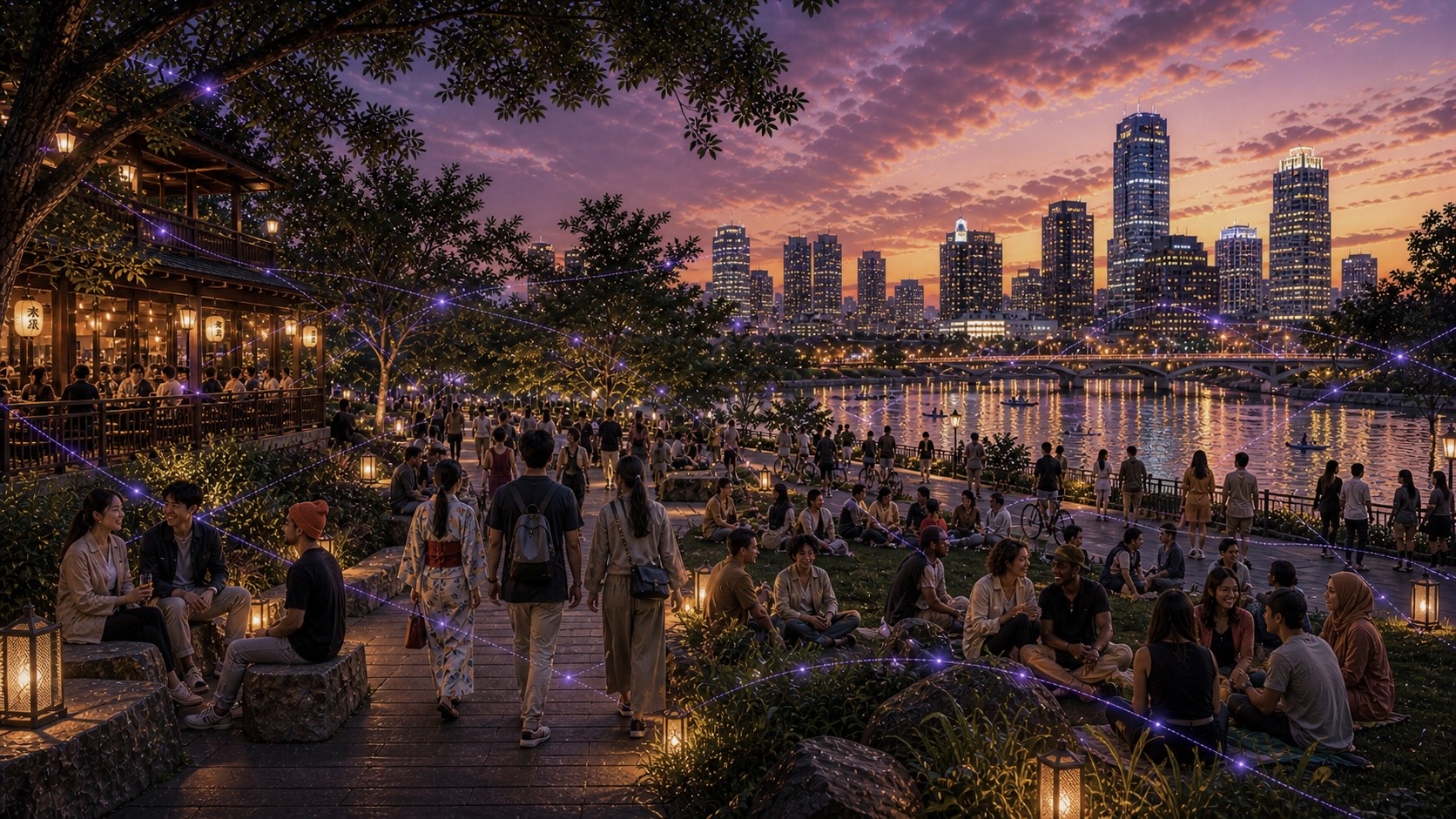
Presence is not created or destroyed, it’s either reminded of or designed away. Cities are ecosystems of people adapting to one another and their environment. They are not machines to optimize, but places where people gather, develop relationships, and build homes. Placemaking is not the act of constructing buildings and then layering sensors, data, and systems onto them to increase efficiency. It is about maintaining humans as the living intelligence of the city, and understanding how people, spaces, behaviors, technologies, and cultures relate, respond, and evolve together as one cohesive system.
The effort must be distributed instead of centralized, like neighborhood streets that self-regulate through social awareness rather than top-down enforcement, and shaped instead of imposed, like public spaces that invite gathering through design rather than mandate behavior through rules. We are beginning to see this shift in projects like the Andorra Living Lab by the Smart Cities group at the MIT Media Lab, where anonymized telecom data is used to understand how people move through the French alpine town across seasons, events, and time, while patterns from digital activity and social signals begin to surface the emotional rhythms of a place.
Instead of designing based on assumptions, the city becomes something that can be observed, modeled, and adapted in response to real behavior. The goal is not control, but alignment and adaptability, designing environments that respond to how we live rather than forcing people to adapt to systems as they were designed. An intelligent city does not simply optimize movement. It creates belonging, presence, and collective rhythm, with technology supporting that rhythm, quietl reinforcing human connection, not replacing it.
The Tension of Technology TTT
The medium is the message.
- Marshall McLuhan

The same tool can return your attention, or pull it away. Technology can reveal intelligence, but it can also distort it. This is the tension of life today. Social media, TikTok, Instagram, likes, views, and engagement loops are designed to capture attention. These systems create feedback loops, but not always the kind that bring us into awareness. Instead, they reflect what we already engage with, surrounding us with familiar thoughts, preferences, and people, until our perception of reality begins to narrow.
What we see starts to feel like truth, when it is often just an amplified reflection of us. This enhances comparison, ego, performance, distraction, and anxiety. In that version of technology, the system becomes intelligent, while the human becomes less present. We see this in AI as well. Large language models can generate insight, but also hallucinate. They can guide thinking, or quietly pull users into loops of confirmation and projection. The system reflects us, but not always clearly.
Technology itself is not inherently the problem. The issue lies in how we design it, use it, and integrate it. AI, sensors, and networks can help us understand patterns, restore connection, and imagine safer, more responsive, and more intuitive environments. But technology is just the amplifier. The real question is, what are we choosing to amplify? As devices multiply and move closer to us, from in, screens to wearables, to what may eventually live within us, the boundary between human and system continues to dissolve. It is no longer about how fast we can build, but whether we are becoming more aware, or more absorbed, in what we create.
Environments mirror our inner world
Constantly regard the universe as one living being.
- Marcus Aurelius

When intelligence is true, it disappears. It no longer asks to be seen, measured, or named. It moves quietly, through space, through timing, through us. Technology, at its highest expression, does not feel like technology. It feels like alignment. As everything integrates, intelligence becomes ambient. It leaves the screen and enters the environment. It lives in the rhythm of a street, the timing of a signal, the feeling of being guided without force. The boundary dissolves. There are no more users, only participants within systems that respond, listen, and adapt.
This is why the inner world matters. The dreamstate is not separate from what we build, it is the source of it. Every system carries an imprint. If it is shaped by fear, speed, extraction, or ego, it will echo that back to us. If it is shaped by presence, coherence, beauty, and care, it will echo that too. In the end, an environment is not intelligent because it optimizes behavior, but because it reveals the consciousness that created it.The future of cities is not louder systems, faster automation, or more visible intelligence. It is something quieter. More coherent. More alive.
A world where intelligence is no longer something we use, but something we live inside.
2026 relatable dreamstate