SEEDs
Ideas and views expressed are my own, outside professional responsibilities, and do not represent employers or any affiliated or mentioned organizations.
the origin
Look within. Within is the fountain of good, and it will ever bubble up if you will ever dig.
- Marcus Aurelius
a family of builders
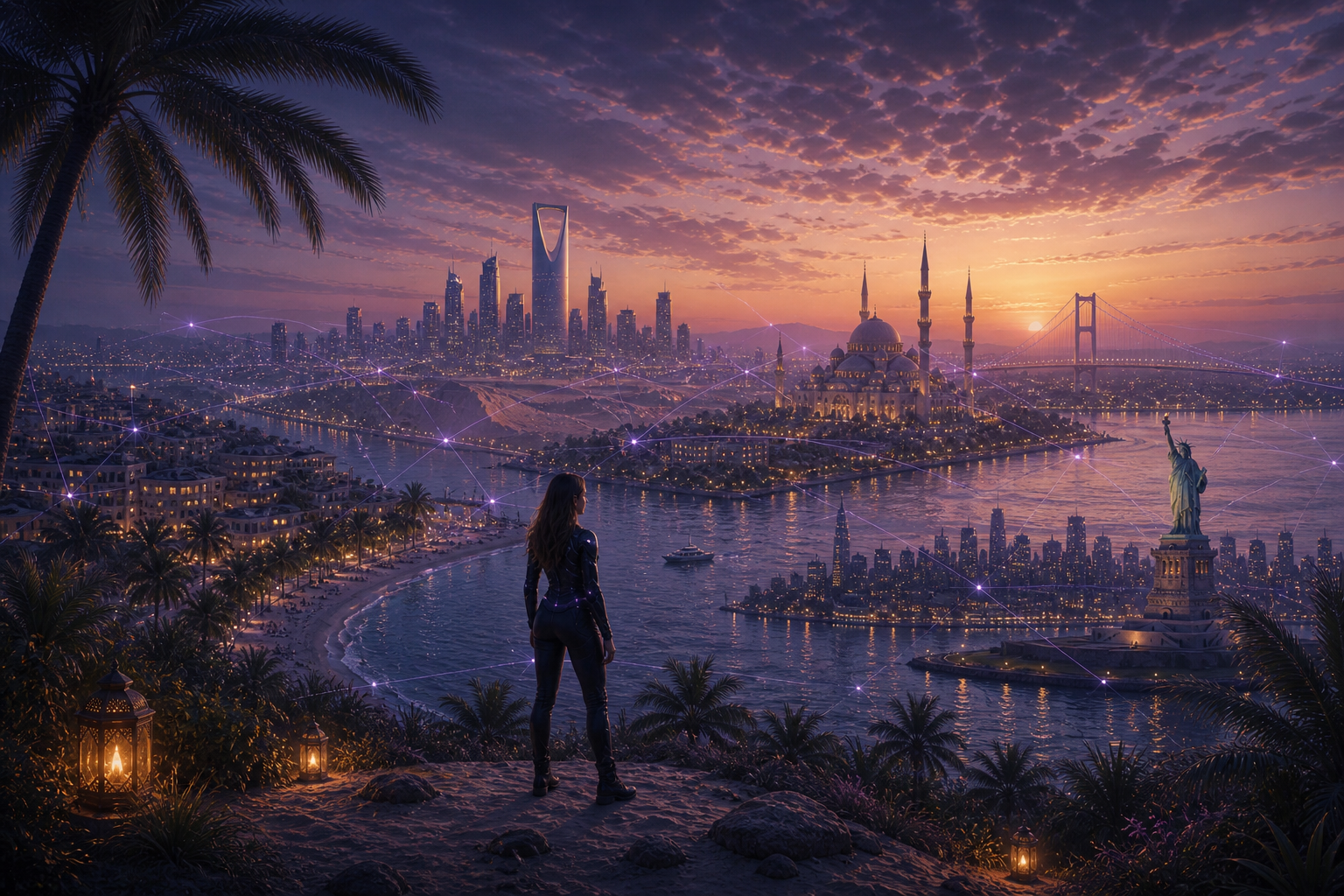
Najjar means carpenter in Lebanese, the original form of a builder. That feels poetic because in 1994 in Montreal, Canada, I was born into the Najjar lineage, a family whose story helped shape physical and digital landscapes across the Middle East. My grandfather, Fouad Najjar, established the East and West mini department stores in Al Khobar, Saudi Arabia, developing one of the first concepts to bring everything normally found in an over-the-counter or streetside shop under one roof.
When my father was six, MEA Flight #444 crashed, and Fouad was lost to the waters of the Arabian Gulf. My grandmother later remarried Abdullah Tariki, who became another strong role model in our family. Tariki was Saudi Arabia’s first Oil Minister, the first Saudi to sit on the board of Aramco, the Arabian American Oil Company, and co-founder of OPEC, the Organization of Petroleum Exporting Countries.
bringing a country online
Tariki mentored my father, who studied chemical engineering before following his passion for technology and founding Nesma Internet in 1998 under a conglomerate. He helped bring Saudi Arabia online during the early internet era, growing Nesma into one of the Kingdom’s largest Internet Service Providers and serving as CEO across its telecom and technology ventures for over two decades. The generations before me were builders who pioneered systems that shaped how people lived and connected.
personal connection
Long before I had language for it, I was drawn to the invisible forces beneath how people live, connect, and move through cities. Raised in Saudi Arabia, I attended the American International School in Riyadh from elementary through high school. I traveled widely, from India to Morocco, and spent summers visiting relatives scattered across Beirut, Cairo, London, and Dubai.
Over three decades, I have experienced juxtaposing versions of myself, from Saudi-Reem to Miami-Reem. I became drawn to enhancing how people experience their environments, from the physical to the digital. I have seen firsthand how settings and systems profoundly affect our well-being. They shape who we are, who we become, and the lives we are able to build.
understanding environments
There is no logic that can be superimposed on the city; people make it, and it is to them, not buildings, that we must fit our plans.
- Jane Jacobs
the life between buildings
In 2012, just before I turned eighteen, I left home to study Architecture at the University of Miami. The school was led by Dean Elizabeth Plater-Zyberk, co-founder of New Urbanism, a city planning movement promoting walkable, mixed-use, human-scaled neighborhoods that foster community. Under her leadership, I learned to think of cities as environments designed for human connection.
Growing up between East and West taught me how society shapes the way people use space, a perspective that surfaced in my work. During architectural reviews, Plater-Zyberk often emphasized “the life between buildings.” Beyond form and function, she focused on how environments shape the ways people gather, interact, and experience the world. I began to see cities as dynamic environments shaped by culture, movement, and human behavior.
cities are not just plans we design, but living environments we must learn to understand.
from concept to construction
After graduating with a Bachelor of Architecture and an additional major in Economics, which I felt was necessary to understand the forces shaping our world, I moved to Dallas in 2017 for my first professional role at LRK. There, I spearheaded architectural design for my first real-world project, The Salty Donut Coffee Shop in Dallas’s Bishop Arts District.
The project had a special place in my heart for three reasons. Its co-founder, Amanda Pizarro-Rodriguez, who I genuinely enjoyed collaborating with, had developed the concept during her own time at the University of Miami. The Dallas location was the brand’s first expansion beyond Miami, mirroring my own move. And coffee shops have always been my favorite third space.
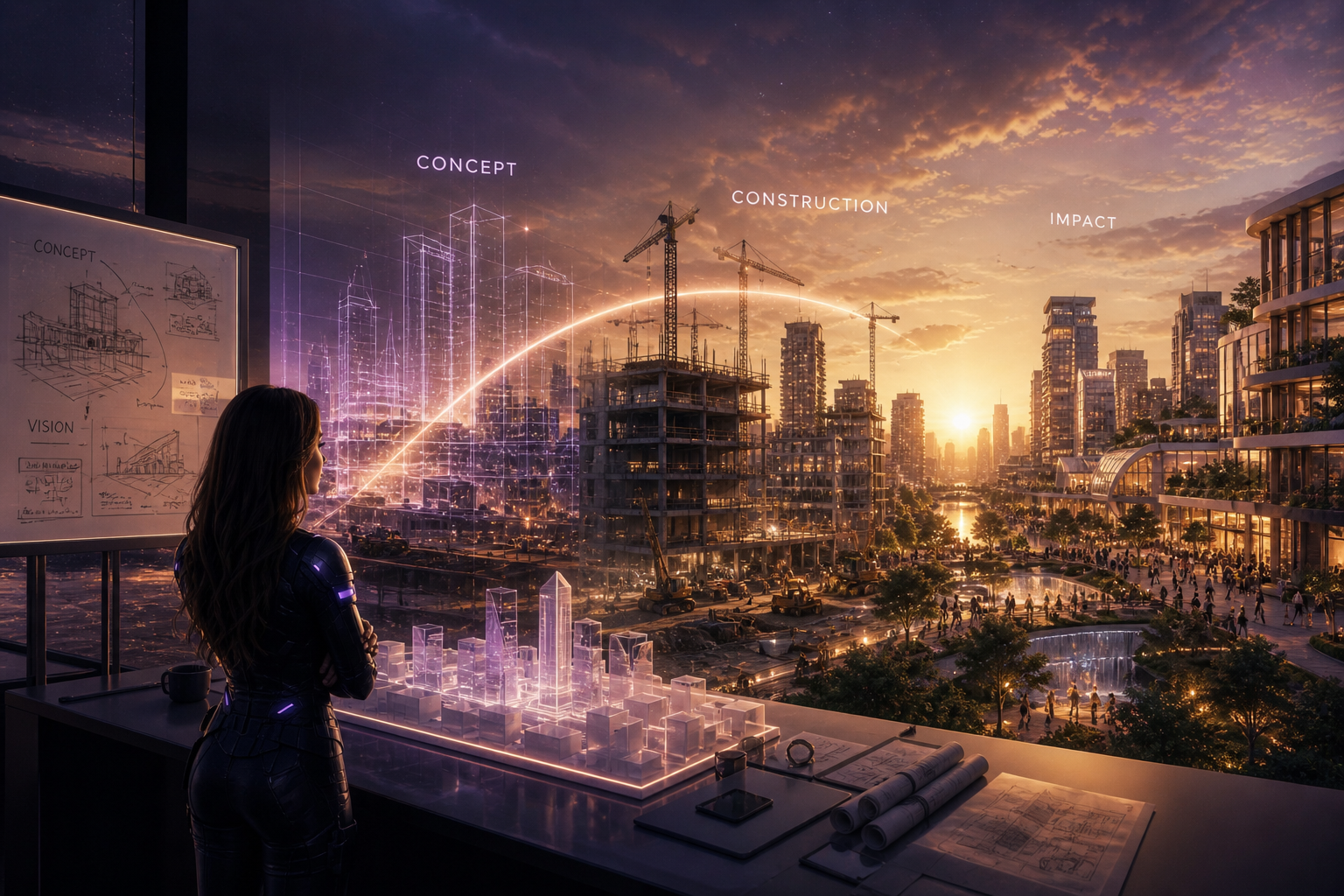
Watching the project evolve from concept to construction showed me how ideas become tangible forms that shape how people move, feel, and interact with the world.
designing for a digital world

Technology alone is not enough. It’s technology married with the humanities that yields the results that make our hearts sing.
- John Maeda
the sims
After eight years studying and practicing the art and science of architecture, I wanted to layer in my lifelong curiosity for technology. Growing up, my favorite game was The Sims, though I spent more time using the motherlode cheat code to build the spaces and places than playing with the characters who inhabited them. That was my game. I have always enjoyed designing and visualizing environments before they existed, so it was no surprise that 3D modeling became my favorite part of the world of architecture.
apple and ux
That curiosity led me to explore how digital experiences shape our environments, and eventually to User Experience Design. Through Apple, Steve Jobs helped show the world the competitive advantage UX could bring. While he did not invent UX, he made the world care about it.
architecture and ux
My first published article, for the UX Collective, explored the parallels between architecture and UX. Both shape how people move through the world. Architecture considers circulation, scale, and spatial behavior, while UX considers navigation, interaction, and user flow. Both design environments people inhabit, just in different modes and mediums. I began to see Product Managers as Real Estate Developers and Software Engineers as General Contractors. The same song, played in different keys.
doubling down on learning
In January 2020, I took a risk and left my stable architectural design job for a UX Design program at SMU, exploring how design moves from schematics to specifications in technology. I had no idea the world was about to shut down. When the pandemic hit, hiring froze overnight and my path became uncertain. I spent that spring and summer doubling down on learning.
I completed courses in Smart Cities from the MIT Media Lab and Strategic Management from Wharton, and applied to every entry level UX role I could find on LinkedIn. I also put all my eggs in one basket with a single graduate school application to my dream program at the University of Southern California.
cross-disciplinary everything
To develop a complete mind: Study the science of art. Study the art of science.
- Leonardo Da Vinci
design, business, and technology
Jimmy Iovine and Andre “Dr. Dre” Young built Beats at the intersection of culture, design, business, and technology before selling it to Apple. Along the way, they realized how rare it was to find people who could move fluidly across design, business, and technology. Too often, people understood two but not the third. They believed innovation required all three, leading them to found USC’s Iovine and Young Academy around that intersection.
In 2020, three years after the school launched its first graduate degree, I joined the 10th cohort of the Master of Science in Integrated Design, Business, and Technology. I collaborated with students across disciplines on projects ranging from a contract with Harvard Business Publishing, transforming traditional business case studies into gamified digital experiences, to exploring the future of retail stores for GameStop’s Director of New Formats. The experience reinforced that the most interesting ideas emerge at the intersection of disciplines.
imagining futures
In my favorite class, speculative storytelling and strategic foresight, we learned frameworks used by futurists to analyze data, technology, and trends, identify potential scenarios, and help organizations prepare. The Four Futures framework imagines an industry through growth, collapse, constraint, and transformation. The Futures Cone maps possibilities from the present baseline through near-term signals, mid-term structural shifts, and long-term civilization changes.
I explored housing and urban living, imagining development expanding through technology, then a market collapsing under economic and environmental pressures, followed by constraints as scarcity reshaped ownership and density.
I imagined a future split between dense, technologically advanced, corporate-controlled urban infrastructure and simpler natural communities inspired by Neri Oxman’s material ecology and biologically inspired Silk Pavilion.
cities behave less like static machines and more like living organisms and systems, adapting to technology, environment, and human behavior.
technology bringing cities to life

We are called to be architects of the future, not its victims.
- Buckminster Fuller
building for public safety
In fall 2021, I moved to New York City, crossing off a bucket list item made possible by the remote work digital nomad life many tech roles enabled after the pandemic. The following spring, I received an offer to join Oracle’s Local Government team as a UX Design Lead within its Public Safety Suite. The business unit was about a year into building the platform, with no products live yet.
It functioned like a startup within a larger corporation, an exciting place to build, iterate, and learn by wearing multiple hats, with resources from one of the world’s largest software companies. I spearheaded design for the first product to go live. Like the Salty Donut project, it reinforced how quickly ideas and designs can move from concept to creation and have real-world impact.
information into action
Oracle’s origins in the late 1970s included a database project for the CIA called Oracle. The idea was simple but powerful, organize massive amounts of information securely so organizations could make better decisions. Decades later, that philosophy still shapes its public safety strategy, helping first responders work more simply and productively so they can build trust with the communities they serve. I believe the future sits at the intersection of public safety, healthcare, digital infrastructure, and the smart city ecosystem.
Nearly five years at Oracle have deepened my understanding of how technology shapes the way cities function and how communities experience safety and well-being.
an inflection point
The year 2026 feels like an inflection point. Artificial Intelligence is moving beyond experimental hype into nearly every layer of society, economy, and governance. It is beginning to converge with biology, advanced computation, and the infrastructure that shapes our world. This reinforces my understanding of cities as dynamic ecosystems that sense, learn, evolve, and respond.
smart cities are living organisms

You can't connect the dots looking forward, you can only connect them looking backwards. So you have to trust that the dots will somehow connect in your future. - Steve Jobs
technology and biology
At Oracle, I realized I was in the right place to understand how technology could influence the built environment, adding to the stack of knowledge I had been building since architecture.
advanced technological systems increasingly mirror the organization of biological systems.
the digital organism
Through this lens, Oracle’s JavaScript Extension Toolkit, JET, resembles a neural interface for building applications. The Public Safety and Security Suite, OPSS, acts like a brain coordinating decisions and responses, while Oracle Cloud Infrastructure, OCI, serves as a nervous system transmitting signals across the network. Oracle Spatial provides situational awareness, Digital Evidence systems serve as institutional memory, and Wearable Computer Systems act as human sensors feeding information into the platform.
As humans adapt and evolve, so does technology. New initiatives expand the stack, with the Oracle Ambulance platform announced in 2026 resembling a circulatory system moving through the city. Together, these layers resemble a digital organism, a unified internal platform or body that integrates with an evolving external ecosystem of smart city technologies, from drones to ground-based sensors.
the human experience
Today I live in Austin, Texas, the fifth city I have called home, and often return to Istanbul, Turkey, where my family now lives. Through this blog, I plan to share insights from the places I have been, mentors I have learned from, and environments I have helped design. I hope to shed light on how we can prioritize the human experience as technology, biology, computing, and infrastructure converge.
My life experiences and multidisciplinary career across design and technology have been a journey toward understanding how to design in ways that respect humans. In many ways, it feels like a continuation of the generations before me, designing systems that shape how people connect and live.
see you in the dreamstate
The relatableDreamstate blog will be very Reem-coded, written from coffee shops around the world and layered with my interests, from Stoic philosophy to Smart City technology. I believe writing is one of the best ways to explore our internal worlds and better understand the forces shaping our external one.
It is impossible for a man to learn what he thinks he already knows.
- Epictetus
I promise to stay curious.